
Alireza Mahyari
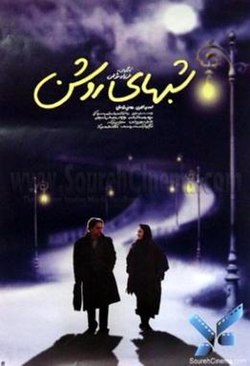
Bright Nights (Persian: Shabhaye Roshan) is a 2003 Iranian film directed by Farzad Motamen and written by Saeed Aghighi. The film is a free adaptation of Fyodor Dostoevsky’s short story White Nights and
also serves as a reinterpretation of the Italian film Le Notti Bianche.
Starring Mehdi Ahmadi and Hanieh Tavassoli, Bright Nights has gradually become a cult classic in Iranian cinema, remaining memorable more than two decades after its release.
Plot Summary
Bright Nights tells the story of two lonely individuals whose paths cross during a series of nocturnal encounters.
The male protagonist, a withdrawn university professor, is socially disillusioned and philosophically pessimistic. He spends his solitary life teaching literature, reading books, and wandering aimlessly through the city streets at night. One evening, he notices a young woman carrying a suitcase and helps her escape harassment by a taxi driver. This encounter marks the beginning of a fragile friendship between him and Roya.
Roya has returned to a specific meeting place based on a promise she made to her former lover, Amir. She has vowed to wait for him for four consecutive nights, exactly one year after their last meeting. The professor offers Roya emotional support and helps her search for Amir. Over the course of these four nights, a deep emotional bond gradually forms between them.
Eventually, the professor decides to propose marriage to Roya. However, on the fourth night, Amir finally appears. Roya leaves with him, and the professor is once again left alone—confronting loss, solitude, and unfulfilled love.
Bright Nights and the Architecture of Tehran
Although Bright Nights revolves around two main characters, many critics believe that the third and most significant presence in the film is the city of Tehran itself.
Throughout the film, the professor frequently reflects on the city—its buildings, its streets, and the experience of getting lost within it. Tehran is not merely a backdrop; it actively shapes the mood, rhythm, and emotional depth of the narrative. The city’s nocturnal streets, forgotten corners, and transitional urban spaces mirror the characters’ loneliness and emotional uncertainty.
From today’s perspective, more than twenty years after the film’s production, the images of Tehran captured in Bright Nights have become historically and visually compelling. These scenes offer a rare cinematic record of the city’s urban fabric in the early 2000s—many of which can now be seen through curated archives such as the “Tehran Camera” Instagram page.
Bright Nights is therefore a film that cannot be fully understood without examining its urban context. The architecture, streets, and atmosphere of Tehran function as an essential narrative layer, transforming the city into a silent yet powerful character.
💬 نظرات کاربران
📝 افزودن نظر جدید